::press::
resume
Miami Highlights: Basel and Aqua by
New American Paintings
Eleanor Harwood Artists highlighted by
New American Paintings Blog:
KNIGHTS ART REVIEW OF UNSOLICITED AT PENTIMENTI GALLERY

Francesca Pastine, “Unsolicited Collaboration with Kara
Walker, Artforum Excavation Series.”
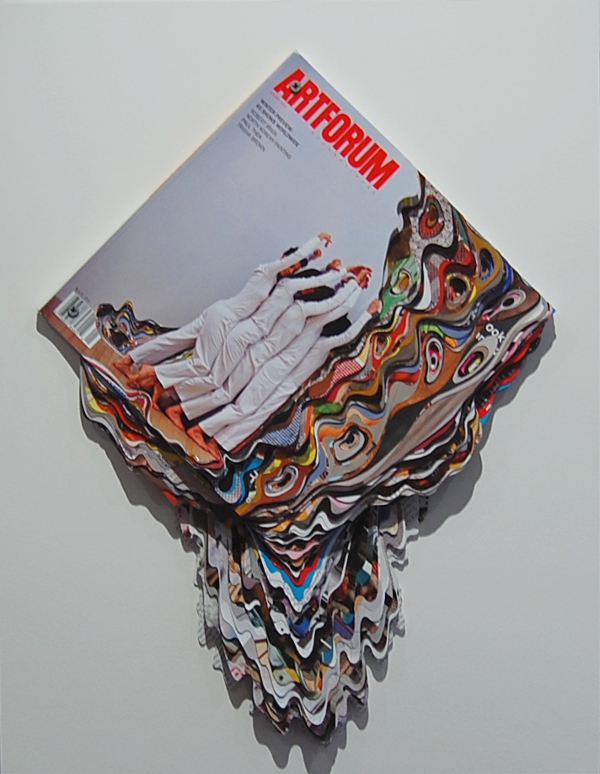
Francesca Pastine, “Artforum 45.”

Re-View
We check out the opulent “This is Elsewhere” at Pentimenti Gallery.
...[w]hile not exactly landscape, Tileston’s work
undeniably has a spatial, topographic element, and
Christine Pfister, who runs Pentimenti, has cleverly
paired it with a sister show — “Unsolicited,” Francesca
Pastine’s X-Acto dissections of contemporary-art
periodical Artforum.
Artforum, if you’re not familiar, is kind of like
the art-world Vogue, in that its editorial pages
of writing and photo spreads are at least matched in
number by tons of gorgeous, luxe-y advertisements in
brilliant colors. Pastine’s “excavations” take advantage
of the magazine’s square format and high-production-value
colors: She fans out pages beyond the glossy’s border and
razors away some colored layers of pages to reveal others
underneath. The thick, cut-paper layers, stacked into
topographic masses, are a clear complement to Tileston’s
paintings.
Pastine’s cutaways interact with the
magazines’ cover images, which the artist considers a
“unsolicited collaboration” between herself, the
magazine and the artist featured on the cover. Unlike
the found-book interventions of Ishmael Randall Weeks,
these works don’t feel like a meditation on geography,
architecture, colonization or political space. Rather,
Pastine’s altered magazines feel like a fun
diorama/valentine to the art world — an externally
localized topographic fun-fair that pairs well with
Tileston’s introverted universes.

Not that Artforum magazine ever needed help with its design, but Francesca Pastine, a San Francisco artist who is having her first solo exhibition here, has made it even more visually absorbing by cutting shapes into issues of the famously thick and square glossy with an X-acto blade - an act she considers a kind of unsolicited collaboration with the magazine and the cover artists (Bridget Riley, Kara Walker, Glenn Ligon, and others). Pastine cuts at an angle, leaving the edges of pages, and any number of fleeting art-world trends, temptingly exposed.
SFAQ Interview
SFQA Arts and Culture magazine by Gregory Ito
Post-Apocalyptic Worlds of Alison O.K. Frost, Vanessa Marsh, and Francesca Pastine
Alex Bigman of the East Bay Express reviewed the
Residency Projects exhibit at Kala Art Institute
Chronicle Review, June 8, 2012
Pastine annexes Artforum: The work of San Francisco artist Francesca Pastine has a unique currency. She has rooted it in the fact that almost everyone in the art world takes some note of the art press, but few actually read it. Blame bad writing, a rising tide of post-literacy or blog fatigue, but that's how things stand.
Artforum - a New York publication founded in San Francisco in the early '60s - once did figure, in simpler times, as the house organ of the art world.
But then the art market and criticism and communications technology went global, and New York and Artforum lost their centrality - except as brands.
Pastine treats the Artforum brand - physically - as grist for amazing constructions, or deconstructions, of paper instantly recognizable as her handiwork.
She frequently cuts into issues of the magazine, treating its colorful, advertising-choked pages as geological strata. In the long vertical "Artforum #35 Collaboration With Bruce Nauman (Pour Series)" (2012), blob-like cutouts cascade down through several vertically arrayed September 2007 issues of the magazine, finally drooping beneath the bottom one.
From the physical comedy of Pastine's work, and its ancestry in the de-collage of artists such as Raymond Hains and Mimmo Rotella, emerges a nightmare of visual culture deliquescing into a mercurial substance whose true name may be celebrity or profitability.
Francesca Pastine: Unsolicited: Paper works. Through July 7. Eleanor Harwood Gallery, 1295 Alabama St., S.F. (415) 867-7770. www.eleanor harwood.com.
Pastine annexes Artforum: The work of San Francisco artist Francesca Pastine has a unique currency. She has rooted it in the fact that almost everyone in the art world takes some note of the art press, but few actually read it. Blame bad writing, a rising tide of post-literacy or blog fatigue, but that's how things stand.
Artforum - a New York publication founded in San Francisco in the early '60s - once did figure, in simpler times, as the house organ of the art world.
But then the art market and criticism and communications technology went global, and New York and Artforum lost their centrality - except as brands.
Pastine treats the Artforum brand - physically - as grist for amazing constructions, or deconstructions, of paper instantly recognizable as her handiwork.
She frequently cuts into issues of the magazine, treating its colorful, advertising-choked pages as geological strata. In the long vertical "Artforum #35 Collaboration With Bruce Nauman (Pour Series)" (2012), blob-like cutouts cascade down through several vertically arrayed September 2007 issues of the magazine, finally drooping beneath the bottom one.
From the physical comedy of Pastine's work, and its ancestry in the de-collage of artists such as Raymond Hains and Mimmo Rotella, emerges a nightmare of visual culture deliquescing into a mercurial substance whose true name may be celebrity or profitability.
Francesca Pastine: Unsolicited: Paper works. Through July 7. Eleanor Harwood Gallery, 1295 Alabama St., S.F. (415) 867-7770. www.eleanor harwood.com.
SF Gate Feature on My Work by Kimberly Chun: Kimberly Chun,SF Gate's 96 Hours

One takeaway that artist Francesca Pastine has discovered in using issues of Artforum in her work: Others are just as apt to use those issues to their own ends.
That much was clear when the San Francisco artist showed pieces from her "Artforum Excavation" series at San Jose Institute of Contemporary Art. "I had a set of them, and someone just picked them up," she says.
It's easy to take those fat, glossy issues for granted. "Everyone has them," Pastine muses. "They're the ubiquitous object in every artist's house, and no one seems to want to get rid of them, and it's an interesting format. A rectangle implies continuity, whereas a square is self-contained. It's kind of like an art object to begin with."
Yet what Pastine does goes beyond merely upcycling. She plays off the artwork showcased on the covers of the magazines - be it by Bruce Nauman, Brice Marden or Guy de Cointet - and the sliced-up pages appear to drip and morph like molten psychedelic ooze or teeter and crumble like multimedia strata, pushing beyond the edges of the page.
"Artforum 40: Unsolicited Collaboration With Zoe Leonard, Pour Series," for instance, found Pastine starting with two consecutive color pages of saturated deep green and acid yellow, then cutting into the paper from there.
"It is a collaborative process - it's an object already," she says. "It's not exactly about looking at a blank canvas."
She also constructed a table with a mirrored surface that reflects the Leonard cover. "It's an exciting place for me to go," Pastine says. "I liked that it created an extra dimension in the piece."
Consider the works as a way of cutting into the tastemakers' critical conversation. "I think I use Artforum because it's an iconic symbol of the art world," she says, "and it's a way of synthesizing broader global and publish narratives and immediate personal concerns with a magazine that's something like a totem. It's a power institution and a site of power - and by intervening I'm able to usurp that."
And in some ways the work has allowed the artist - who studied painting at the San Francisco Art Institute, where she has also taught - to break form in more personal ways.
"I'm interested in the physicality of doing it and the physicality apparent in the finished product, so the mark or the idea of the hand creating is very important to me," Pastine says. "If you look at the magazines, the cuts aren't perfect, and the actual magazines are used and marked up as well. They have their own kind of history of usage, which is a good thing for me because I'm kind of a perfectionist, and using magazines for me has actually allowed me to accept imperfection."
Reception 7 p.m. Sat. Through July 7. 11-6 p.m. Wed.-Sat. Eleanor Harwood Gallery, 1295 Alabama St., S.F. (415) 867-7770. www.eleanorharwood.com.
Kimberly Chun is a freelance writer. E-mail: 96hours@sfchronicle.com
"IN THE DARK: THREE CONSIDERATIONS," Kenneth Baker, San Francisco Chronicle, March 5, 2011
The title of the three-person show at Eleanor Harwood's - "In the Dark: Three Considerations" - promises more than the show delivers, but if that brings heightened attention to the work of Toronto artist Niall McClelland, then no matter.
McClelland made each of his three unframed pieces here by blackening an extra-large sheet of photo-copying paper. He then creased, crumpled and flattened it - to an extent - to produce a black field flickering with galaxies of white detail.
Some of the creases form rigid patterns, such as the one-point perspective and parallel diagonals in "Tapestry - Beaten" (2010). But the tracery of vastly many more records the ungovernable collapse of the paper under pressure.
We might interpret McClennand's pieces, with their hints of a cosmic plenum under systematic scrutiny, as abstract figures for humankind's need to master reality with concepts and procedures. But even regarded as empty process exercises, these works honor pleasure in seeing for its own sake as too little contemporary art does.
Joe Bender's oil and alkyd on aluminum paintings show viewers the same respect in different terms, by surrendering their inner complexities only to sustained, desiring attention. The longer you look, the more the paintings declare their visible reality individually, until it becomes difficult to regain your initial impression of their equivalence. As in McClelland's work, that transit has a lyricism that most contemporary art does not incline us to anticipate.
Francesca Pastine temporarily abandoned the flashing humor of her art magazine deconstructions for political statements that bring Sarah Charlesworth's too readily to mind. Pastine has blotted out with graphite all but selected details of pages from the New York Times that expose the moral hypocrisy of wealth and power and media complicity in their mythology. No news, sad to say.
In the Dark: Three Considerations: Paintings and works on paper by Joe Bender, Niall McClelland and Francesca Pastine. Through March 26. Eleanor Harwood Gallery, 1295 Alabama St., S.F. (415) 282-4248. www.eleanorharwood.com.
E-mail Kenneth Baker at kennethbaker@sfchronicle.com.
:::::::::::::::::::::::::::::::::::::::::::::::::::::::::::::::::::::::::::::::::::::::::::::::::::::::::::::::::::::::::::::::::::::::::::::::::::::::::::::
Mu**see**um
Francesca Pastine is good, really good, but her series “Iraqi Casualties” had us freaking out today. Some of the most beautiful lo-fi work we’ve seen in AAAAAAAGES made using some issues of the New York Times and a 9b pencil.
::::::::::::::::::::::::::::::::::::::::::::::::::::::::::::::::::::::::::::::::::::::::::::::::::::::::::::::::::::::::::::::::::::::::::::::::::::::::::::
"IN THE DARK," Visual Art Source, DeWitt Cheng, March 23, 2011
One of the first lessons in Drawing 101 class is that the “negative space” between objects is as important as the shapes of rendered objects. With the discovery of dark matter we might now nervously joke, whistling, that the visible universe is merely what is left over, excluded or extruded from the dark. That conclusion is partially verified by three artists — Joseph Bender, Francesca Pastine and Niall McClelland — who eschew color, preferring the blacker shades of dark. Once your eyes adapt to being “In the Dark,” the subtle joys of tone, texture and context become more important; and maybe your hearing improves, too. . .
Bender’s dark oils or oils/alkyds on 36 x 36” aluminum squares call to mind Ad Reinhardt’s 50”-square black cross paintings of the 1950s. “Addition is Not Subtraction” even employs the familiar cruciform composition; in other works, however, Bender is more severely reductive and monochrome — and ironic, considering titles like “Fabricator of Hidden Riddles,” “Where Dogs and Vultures Meet,” and, of course, “Crepuscular Predilection.” They vary in brushstroke and finish, if not in hue, asserting their materiality as we peer into their opaque “confrontational but contemplative” depths. Pastine works with printed newspaper and graphite in her “Iraq Casualty” series. New York Times cover pages from 2006 to 2008 are obscured with metallic 9B lead strokes, burying most of the type and imagery so that poignant slices of reality — body bags, coffins, a mourner — can expand to assume larger importance. In “Blackout, Section A Series,” she completely coats the paper, suggesting both censorship and mourning. McClelland’s “Tapestry” pieces are arrays of black page-sized rectangles with worn white creases, folds and puckers. They resemble astronomical charts without stars, or maps without geographical features, and reflect, darkly, both 1960s Minimalism and 1970s Process Art.
::::::::::::::::::::::::::::::::::::::::::::::::::::::::::::::::::::::::::::::::::::::::::::
CURATE
:::::::::::::::::::::::::::::::::::::::::::::::::::::::::::::::::::::::::::::::::::::::::::::::::::::::::::::::::::
THE FLOP BOX BLOG
:::::::::::::::::::::::::::::::::::::::::::::::::::::::::::::::::::::::::::::::::::::::::::::::::::::::::::::::::::
THE ART BUISNESS, "OPENINGS," Alan Bamberger
:::::::::::::::::::::::::::::::::::::::::::::::::::::::::::::::::::::::::::::::::::::::::::::::::::::::::::::::::::
"IN THE DARK: THREE CONSIDERATIONS," Happenstand, March 2011
Working in black is sometimes about closing down the available routes to reference, meaning and information. For example, Francesca Pastine's blacked out newspaper pages that leave only visible images of Iraqi casualties of war. She uses black to funnel your attention, to make you look and to mask out the other images and text. Her black in these pieces acts as a pointer. In her entirely blacked out New York Times section A piece she makes the whole tome of data devoid of content altogether. Her obfuscation of "all the news fit to print" asks how valid or not the erased content was.
Other artists such as Joe Bender work with "black" as an immense and subtle color range. This body of his work is a study of all the information available in the color black. The theoretical idea that a perfect balance of all pigments will make the color black is integral to Joe's practice. His play, in oil paint, adjusts the layers of color to bring "color" out within his black paintings ends up being about balance and small shifts bringing out rich tints and shades.
For Niall McClelland working in black and grey scale allows the viewer to connect more easily with his process. This transparency about the process, a system of mark making through folding and xeroxing, fosters an immediate connection between seeing and understanding, and evokes a kind of “back to basics” mentality about art making. Stripped of embellishment, the simplicity and starkness of the work point to the truth behind any art piece - the hand of its maker.
Black can be all colors producing the color black such as in Bender’s work, but it is also an absence of color in that whatever is perceived as black doesn’t put out or reflect light in any part of the visible spectrum. Whatever looks black is absorbing all frequencies of light. Black is everything and nothing at once depending on how you read it. Black can be additive and black can be void. The artists in this show address these understandings, as well as the many cultural, and psychological interpretations of black, and demonstrate, ultimately, the complexity inherent in this color.
:::::::::::::::::::::::::::::::::::::::::::::::::::::::::::::::::::::::::::::::::::::::::::::::::::::::::::::::
FANZINE, "FANZINE DOES NEW YORK ART FAIRS," Bradford Nordeen, March 6, 2011
"I can really only see two ways to approach the next fair I attended, Scope. There are galleries which make it work, who take what they are doing seriously and have preferential placement that allows them to function with a certain autonomy. And it’s a testament to the art, that it is strong enough to demand your critical attention. San Francisco gallerist, Eleanor Harwood does an utterly professional job showcasing Gareth Spor’s Dream Machine (inspired, of course, by Brian Gysin) and Francesca Pastine’s surprisingly solid sculptural landscapes, made from carved-out ArtForums."
:::::::::::::::::::::::::::::::::::::::::::::::::::::::::::::::::::::::::::::::::::::::::::::::::::::::::::::::::
MARIN INDEPENDENT JOURNAL
JANUARY 7, 2009
Working artist: Pastine focuses on physicality of objects
Christine Brenneman
Francesca Pastine's ArtForum series of excavated magazines will be displayed at the Headlands Center for the Arts in Sausalito.
To hear local artist Francesca Pastine tell it, her artistic life began practically at conception. Her mother and father were both working artists, and her childhood was spent immersed in a milieu of paintings, sculpture, art studios and constant talk of the creative process. Pastine, a multimedia artist and painter, now lives and works out of her home in San Francisco's Mission district. There, she creates paper-based sculpture and realistic paintings, often using ordinary materials in her artworks.
This month, Pastine and 19 other California artists will be featured in a group exhibition, "Front + Center," at the Headlands Center for the Arts in Sausalito.
Each participant applied for the center's prestigious artist-in-residence program for 2009; though these applicants did not get the residency, their work was chosen for the annual kickoff exhibition, which showcases up-and-coming artists in a variety of visual media.
Four pieces from Pastine's ArtForum series of "excavated" magazines will be on display.
Q: There's an overarching theme in your work of calling attention to the physical nature of your materials - whether you're painting shopping carts used by the homeless, cutting snowflakes out of the New York Times or chopping into an ArtForum magazine. Can you talk about why that's important to you?
A: In those specific bodies of work, I wanted to work with things that were immediately at hand. I'm interested in the physicality and materiality of objects:
Advertisement
Marin Sonoma Mosquito & Vector Control District
the object-ness of the shopping carts, for example, the piles of things, the ways in which they were covered and piled with blankets. That theme runs through, wanting to deal with what's at hand, things that I'm engaged with on a daily basis. With both the ArtForum and the New York Times, I like how the pages feel, and all those little peripheral marks on the edge of the pages. I'm interested in all of these things as physical objects.
Q: The hand of the artist, and clear evidence of that,
Francesca Pastine's ArtForum series of excavated magazines will be displayed at the Headlands Center for the Arts in Sausalito.
seems paramount in your work. Why?
A: I was very inspired by the women's art movement of the 1970s, which emphasized craft. I got into paper-cutting and paper crafts, and I liked cutting into them and trying to have the trace of my hand in the actual object. This brings the viewer to the present, into a richer experience of seeing. The viewer can have an embodied, visceral experience with the physical act of making when I bring that aspect forth. That's the reason I don't want to laser-cut them.
Q: Can you talk about the pieces you'll have in the "Front + Center" show?
A: There will be four of my ArtForum works (in which she cuts into the venerable art magazine). I consider them an archeological excavation, a dig. I'm digging through the current history of art making and stripping it and exposing it in a physical way, not an abstract way. The reason I was attracted to them was that they are square-shaped. A rectangle represents a portrait or landscape. But with a square, your eye kind of stops, it reads more as a real object.
Q: You teach art at the college level, and have done so for much of your career. How does that feed back into your own art practice?
A: I think it's important to get back to the fundamentals of art, to touch base with that all the time, so that you don't get too far into the conceptual realm. Through teaching, I go back to the reason that art's exciting for me in the first place. It's really gratifying to open up the possibility and potential of art on all levels. People get so much out of this experience; it's gratifying to see how people connect with creativity.
Q: What's your favorite color?
A: That I don't have - but I do love orange.
Q: What is your most prized art possession?
A: The art I have that was made by my parents.
Q: What's the most inspiring thing you see daily?
A: My first cup of coffee.
Q: What one word best describes you as an artist?
A: Dedicated.
Q: What you would do if you didn't make things?
A: There's really nothing else I can do. I'm hopeless at anything else.
IF YOU GO
What: Front + Center, a group exhibition guest-curated by Kimberly Johansson with featured artists: Francesca Pastine, Tamara Albaitis, Brice Bischoff, Todd Bura, Matty Byloos, Ajit Chauhan, Joshua Churchill, Lori Esposito, Mayumi Hamanaka, Taro Hattori, Rachel Mayeri, Jennie Ottinger, Erik Parra, Alison Pebworth, Tara Tucker, Paul Urich, Lindsey White, Noah Wilson, Mary Elizabeth Yarbrough and Ayelet Zohar.
Where: Headlands Center for the Arts, 944 Fort Barry, third floor, Sausalito
Christine Brenneman can be reached at lifestyles@marinij.com. The Working Artist column appears the second Thursday each month.
______________________________________________________________________________________________
http://flavorpill.com/sanfrancisco/search?search_query=francesca+pastine
Front
+
Center
The Headlands Center for the Arts' Residency
Program has
provided a removed perch for California artists, letting
them draw on
the Center's gorgeous natural surroundings and its past
life as part of
the military's Fort Barry. Front + Center — which
alludes to both
militaristic and theatrical forms of staging — finds
local curatorial
wunderkind Kimberly Johansson giving applicants from the
2009 program
their chance to take center stage. The mixed-media show
has many strong
points, but Francesca Pastine's meticulously gutted
issues of Artforum
deserve an extra round of applause.
– Matt Sussman
____________________________________________________________________________________
KQED
ARTS
Art of Democracy: War and Empire
By Jennine Scarboro | Oct 12, 2008
Politics
are
not
subtle, political communication is necessarily fast,
strident,
and goal oriented. The best art on the other hand has
a subtlety and an
ambiguity that inspires contemplation and allows for
multiple
interpretations. I am very interested in the
possibilities offered by
the intersection of politics and art but, because the
two practices are
best formally presented in contradictory ways, it
requires immense
skill to balance the demands that each bring to a
work. Art of
Democracy: War and Empire at the Meridian Gallery had
plenty of pieces
that did not succeed, but among these I discovered
works that did. As I
looked I became aware that the work that most
impressed me put art
first and politics second.
The best pieces in the show are Fernando Botero's
painting Abu Ghraib
#54 and Enrique Chagoya's litho and Chine-colle codex
The Ghost of
Liberty. Both of these works exhibit the inspired
formal mastery of
their makers.
Botero's piece could at first seem to be an obvious
illustration of the
Abu Ghraib torture that horrified many in the US, and
the world, in
2004. His painting however imbues the depiction with a
sorrow and a
livingness that invokes a powerful and different
emotion from the one
the photos evoked. As Kimmelman points out, "The
photos of Abu Ghraib
imply no outrage about what's happening. In fact, the
intent of the
pictures is precisely to compound the humiliation."
These photographs
of atrocities were taken by the instigators of the
atrocities, and as a
result our contemplation is focused on the barbarity
of a viewer who
will witness and record horrible acts without
considering the humanity
of his subjects.
In opposition to this, Botero's work forces one to
consider the
humanity of this narrative's subjects. His figures are
fleshy. The
tender squishiness of their flesh emphasizes the
brutality by which
this flesh has been damaged making us feel them as
fellow humans that
suffer. I feel empathy for the sorrow of their pierced
flesh, for their
forced blindness, for the bindings that cut into their
soft bodies. In
Abu Grhaib #54, two figures are bound together in a
dark barred cell.
The cell that contains them has a strange slanting
perspective. The way
this warped perspective slides us down and out of the
picture
destabilizes the space emphasizing a strangeness and
horror that adds
to the painting's power. The figures are sympathetic,
the space, the
situation in which they exist, wrong. There is
something about hope
here too, a distant hope implied by narrow strip of
light glowing in
the oppressive darkness beyond double sets of cell
bars. The
omnipresence of hope is necessary for survival of dire
and mundane
trauma, and this slender strip speaks to me of the
resonance of hope in
human experience.
Enrique Chagoya's The Ghost of Liberty differs in its
approach both to
content and to formal investigation. Rather than
focusing on a specific
event, Chagoya's piece is thematic. He creates a
magical pastiche of
oppression by giving us a sampling of "imperialist
intervention" and
"arbitrary exercise of violent power" as they occur in
different places
and at different times.
While Botero utilizes the compositional manipulation
of space and a
sensitive rendering of the figures that instills them
with symbolic
meaning, rhythm, scale, color, and image complexity
are the formally
compelling aspects of Chagoya's work. Jesus-headed
dinosaurs,
Chinese-baby astronauts, Mayan gods, and Buddha heads,
are printed in
brilliant hues and collaged into a landscape of
changing conflict. His
hybrid forms are as inventive and delightful as his
subject, the
omnipresence of cultural violations, war, and
political violence. The
tension that holds these opposites together results in
a very exciting
piece.
While I am most insistently drawn to work in which the
formal qualities
are most developed, occasionally a more conceptually
focused piece will
compel me. In The Past as Future, Habermas discusses
what has happened,
in the media, to depictions of war. He presents the
idea that public
opinion was affected by media images during Vietnam in
a way that
created difficulties for US politicians, and that as a
result images of
subsequent conflicts have been edited to reduce
negative public
opinion. Several more conceptually focused artworks
intersected with
these ideas in intriguing ways.
Francesca
Pastine's
pieces from her series Iraqi Casualty Series were
the most interesting
of these. Three pages from the New York Times had
all the text blacked
out with graphite, leaving only barely recognizable
images of covered
bodies, coffins with a sprinkling of dirt, and a
stack of diamond
rings. Again the formal qualities are important to
the success of the
work although the emphasis here is on how they are
used to present a
criticality interesting idea.
The density of
the
graphite darkness obliterates meaning, transforming
information into
unreadable black columns; censorship is an obvious
implication and the
resulting form speaks directly to ideas that our
media, in this case
the New York Times, is being edited obscuring truth
as it reveals only
partial events. The difficulty of identifying the
imagery, which has
had its surroundings erased by blackness, references
the difficulty of
comprehension when context is stolen from us.
I was happy to find work in this show, which both
compelled me as art
and allowed me to ponder political themes in
interesting ways that
standard political communication does not usually
engage.
Art of Democracy: War and Empire is on display at the
Meridian Gallery
through November 4, 2008. For more information, visit
meridiangallery.org.
_________________________________________________________________________________________________________
The
San Francisco Chronicle
Kenneth Baker, May 31, 2008
Pastine at the Lab: Congratulations to Francesca Pastine for making Artforum involving again.
Decades ago, in simpler times, people actually looked forward to reading the magazine, when it served as the New York art world's journal of record. Since then, Artforum has followed the trajectory of the art market itself, retailing moneyed glamour and the atmospherics of contemporary art. Meanwhile, most of the intellectual substance has shifted to its outrigger, Bookforum.
Each issue of Artforum now boasts slab-like bulk and a power like kryptonite to drain the strength of any art professional who tries to face it.
But in an ingenious series showing at the Lab, Pastine has found in the magazine the makings of memorable art, by means connected incidentally to Villeglé's practice.
In "Artforums 2001: (Artforum Excavation Series)" (2008), she has meticulously carved a crater in a stack of 2001 issues. At one corner of the top cover - December - we can make out the remains of a tone-deaf banner: "Best of 2001."
The hole Pastine has cut in the magazines, stratified with color from their glossy pages, irresistibly brings to mind the physical and emotional voids left by Sept. 11 massacres.
In a related piece without obvious topical reference, she has cut an irregular hole - again looking something like a comic-book strip mine - into a single issue of the magazine, exposing a page apparently empty of all but a soft gray glow.
In
two
other
series here, Pastine has selectively effaced pages from
the New York Times to expose not very deeply underlying
contradictions,
such as the collision of values in advertising and war
news or
fashions' real and ostensible values to the women who
model them and
those who covet them.
Francesca
Pastine:
Alterations:
Disfigured magazines and newspaper pages; The Lab,
2948 16th St., San
Francisco.
Ripping It Up
SF WEEKLEY, By Hiya Swanhuyser, May 28, 2008
Francesca
Pastine,
Alterations:
A 9B pencil is the softest pencil available: It's almost
liquid. If it
weren't made of lead it would make great eyeliner. An
artist can choose
to use a light touch with it, of course, but Francesca
Pastine doesn't.
At "Alterations,"
she shows three series, two of which involve the heavy
application of
graphite to newsprint, and one she made by slicing and
curling Artforum
magazines. She's interested in print publications,
clearly. Back to the
9Bs: "Invisible Women" and "Iraqi Casualty" find Pastine
layering their
lead over pages of the New York Times in order to
highlight
certain images. The result reminds us of John Lennon's FBI
file; the
artist thinks it looks like "graphite leaf." Either way,
her chosen
photos stand out in a sea of darkest black while the
paper's uncovered,
datestamped edges remind the viewer of their official
status. In the
third series, "Artforum Excavations," exploded
versions of the
ultra-glossy last word in creative trends show an
attitudinal, literal
stab back at a publication that probably irritates a lot
of artists.
May 29-June 14, 2008
May 29-June 14, 2008
reviewed by David Buuck
"Francesca Pastine's wonderful paint-objects combined a tactile engagement with paint and a sculptural approach to display that resulted in some of the strongest work in the show. Pastine paints canvases in thick, colorful oils, then cuts out segments and patterns, allowing them to hang down in patterns that upset conventional expectations of painting. Her Doorknob Cozy takes this further, by draping a large, patterned paint "skin" over a doorknob installed in a gallery wall, creating a useless adornment that carried uncanny power."
reviewed by Kennith Baker
"Francesca Pastine's work looks like something left over from a differnt show, but it makes a striking impression, especially her Football Cutouts . In each of these she has printed a sports page photo on Japanese inkjet paper, and with scissors or mat knife cut it into a frilly stencil, the incisions intervening comically or critically in the image."
Artweek, July/August, 2003
Previews, Debra Koppman
"From a 23-inch diameter slice of the tree, Francesca Pastine created Reflect, a deep bluish-green, well-like ellipse. This space functioned both as a deep hole and as a site of reflection, creating an ambiguous boundary between the viewer and the work. As viewers see themselves and their environment mirrored in the work, they are invited to reflect upon their own relationships to the human and the not-human worlds in which they live."
New Work: Racheal Neubauer
Rena Bransten Gallery
November 21, 2002 - January 4, 2003
reviewed by Amy Berk, in WWW.STRETCHER.COM
Lusciously erotic and formally inventive, the artworks in Abstraction , and New Work: Rachael Neubuer made a fantastic paring. The artists in both exhibition, one of painting and the other of sculpture, relish surface textures and utilize color playfully and gracefully, to great effect.
Pastels pervade the galleries. Pause in the Landscape (2002), Jessica Snow's delightfully contained small acrylic painting, appears on target in size and chroma. Her larger work, Orbit (2002), seems less focused. Using white pins and yarn, the boxes of this painting continue off the panel and onto the wall, but the effect here is not as successful as her other efforts in a similar vein. Here, the combination of material, form and shadow lacks cohesion.
Electrifying shadows activate two new works by Francesca Pastine. In Curl and Space Between Pink (both in 2002) Pastine uses a material close to my heart, Styrofoam, as a base for her tricky cut-outs. This cut-out treatment appears to pay homage to recent work by sister gallery artist Irene Pijoan, whose delicate paper cut-outs have been standouts in a rich gallery program. Pastine, however, employs painted aluminum, delicately slicing the material and pinning the intricate construction onto white Styrofoam. A deep velvety green unfurls behind a duller gray in Curl.
More eroticism is present in the hairs, nipples and oozings of Paul Henry Ramirez's work. He presents two untitled works on paper, one from the Space Addiction series (2002) and one from the Edging into Excess series (1999). Ramirez effectively utilizes layering and texture in both works. The show is rounded out by two untitled graphite drawings by Pastine (2000) and a large oil painting by Amy Wilson. While they are strong works, they do not seem to fit well with the rest of the show's innovation and whimsy.
In the next gallery, Rachael Neubauer presents physical manifestations of some of the ideas presented in paint in Abstraction . Her mixed media forms share highly polished surfaces and a strange sexual charge. All are precariously attached to the wall, save one lone floor piece, and a tension develops as one wonders when gravity will have its wicked way with these bulbous forms.
Neubauer's fertile imagination continues to produce forms resonant with the body, bloated with desire, oddly inert, and fun. Her muted palette of blue, brown, mustard, taupe and green provides startling contrast to the jewel of the show In her first foray into bronze, Neubauer has created a Brancusian form with shadows galore whose reflective surface sparks an internal dialogue on content along with providing the pure enjoyment of its formal coherence, Lovely (and almost sold out) small drawings on photo paper further link her physical forms with the two dimensional language advanced in Abstraction.
The pairing of these two beautifully nuance and balanced exhibitions is a treat for the senses.
Artweek, February 2003, Volume 94, Issue 1
reviewed by Laura Richard Janku
"Scalloping waves form boundaries between textured graphite and solid fields of yellow gouache or white paper in Francesca Pastine's two untitled drawings. In her lacy wall sculptures, negative and positive are interwoven in an intricate pattern of decoupage. Created from sheets of dried acrylic paint, the weighty tendrils tumble over themselves like bas relief seaweed, revealing innards and inner colors. The work is affixed with dress pins to plain white Styrofoam-- whose cellular pattern distracts more than it adds-- the skin of the paint draping down in a fabric like manner."
The Argus, The Review, The Tribune, The Herald, The Times Star
reviewed by Monique Beeker
"After studying some paintings by San Francisco artist Francesca Pastine, a woman who had spent most of the day scrubbing her bathtub told Pastine that she once experienced a revelation about the art she had seen.
"They're about the invisibility of women's work." the woman said.
The artist did not disagree. "I seek to make the invisible seen, and the visible submerged." Pastine writes in an artist's statement posted alongside her work in Surface Tension. "As in traditional women's work that requires a care and attentiveness often overlooked, the details within paintings become subsumed into the whole."
The steel canvases she favors feature rounded corners and edges tucked under as neatly as linens tucked between mattresses. The potential coldness of the surface, however, is warmed by the organic forms she depicts. In "Silver Lining: (2001), Pastine paints three wandering rows of flowers with diaphanous pastel petals dancing in space. No single bloom is distinct from it's neighbors. rather, they overlap and create a connected whole."
Vol. 9, No. 5
October 21-27, 1999
Page 39
DOMESTIC MINIMALISM
Kustom Kitchen Kulture
by Erick Fredericksen
FRANCESCA PASTINE is
a San
Francisco Artist whose work seems Southern California:
L.A. cool, not
S.F. funk; 20th century L.A., not 19th Century S.F.
Her
paintings, now showing in the cramped back hallway at
James Harris
Gallery, start with a smooth sheet
of industrial stainless steel, its edges folded over
into smooth,
rounded edges. She paints directly onto the metal,
without gesso,
undercoat, or any other preparation. Really
looking at the
surface of this material is revelatory for anyone who,
for reasons of
inebriation or just mental tiredness, has found himself
contemplating
the top of a garbage can would testify. Gray,
silver, or black in
spots-- depending on lighting and variations in the
surface-- the steel
carries a cool glow with glimmering,
jewel-like highlights. Respecting her materials,
Pastine
paints only lightly on this surface, leaving much of it
exposed.
Pastine's painting hand is loose yet tidy, covering the sheet with repeated forms which range from thin, wavering lines to small, stenciled blots that resemble potato prints. There are links with mid-century art, from the minimalist grid loosely laid over one of Silent Treatment's (1999) two panels to the abstract, expressionist influenced composition of a 1998 untitled work--but I wouldn't make a simple equation out of this fact. Pastine's work draws as much from the vernacular culture of post-war America as from its art specifically, Kustom Kulture auto pinstriping, and kitchen and bathrooms.
The kitchens and the bathrooms are the easiest to tease out. Pastine's colors tend toward pale pink, avocado green, sky blue and bright yellow--all colors associated with '60s refrigerators, ovens, sinks and tiles. Her forms are similarly domestic: little heart shapes arranged in flower-petal-like groups of five in Silent Treatment and Flutter (1998), a budding tree branch form in Untitled (1996), and a curving, single line shape in the left panel of Untitled (1998) that resembles both a loose rubber band (seen as a line), and the sandpapery, flower-shaped stick-ons that keep you from slipping and bonking your head in the tub (seen as a solid).
The pinstriping reference is probably unintentional, but it's there in the sleek, thin line of her brush, in the curves of that line, in the shininess of her metal support. But it's a loose link: Pinstripers tend to take simple shapes of images and work them into baroque, vibrating, barely readable forms composed of many curving, crossing lines, while Pastine's complexity comes from overlapping simple shapes. it's two different sorts of blur. The common ground is found in a much larger tradition of decorative arts--call it "more is more." Pure description and plainness are enemies of this tradition, which loves detail and richness.
Pastines's diptychs tend to contrast feminine and masculine forms. The aforementioned Silent Treatment has the little heart shapes next to a steel sheet covered in a grid of spindly lines, like country home stencil-shapes matched up with graph paper. But Pastine's grid is not strict: formed of loose, slightly wavering lines, it brings to mind Agnes Martin's delicate, human--and feminine--minimalist drawings. Pastine's positioning is remarkable, poised at the intersection of two large art trends: feminized minimalism with no taste of of brutal machismo, and minimalism which refers to the world outside of the hermetic discourse of art.
Which should lead me out of the art and into that world, I suppose, but it doesn't. This is not disappointing to me, though. Pastine's real-world references are important to her art, but it's less fun to think about those connections than it is to simply revel in the beauty of the work.
Pastine's painting hand is loose yet tidy, covering the sheet with repeated forms which range from thin, wavering lines to small, stenciled blots that resemble potato prints. There are links with mid-century art, from the minimalist grid loosely laid over one of Silent Treatment's (1999) two panels to the abstract, expressionist influenced composition of a 1998 untitled work--but I wouldn't make a simple equation out of this fact. Pastine's work draws as much from the vernacular culture of post-war America as from its art specifically, Kustom Kulture auto pinstriping, and kitchen and bathrooms.
The kitchens and the bathrooms are the easiest to tease out. Pastine's colors tend toward pale pink, avocado green, sky blue and bright yellow--all colors associated with '60s refrigerators, ovens, sinks and tiles. Her forms are similarly domestic: little heart shapes arranged in flower-petal-like groups of five in Silent Treatment and Flutter (1998), a budding tree branch form in Untitled (1996), and a curving, single line shape in the left panel of Untitled (1998) that resembles both a loose rubber band (seen as a line), and the sandpapery, flower-shaped stick-ons that keep you from slipping and bonking your head in the tub (seen as a solid).
The pinstriping reference is probably unintentional, but it's there in the sleek, thin line of her brush, in the curves of that line, in the shininess of her metal support. But it's a loose link: Pinstripers tend to take simple shapes of images and work them into baroque, vibrating, barely readable forms composed of many curving, crossing lines, while Pastine's complexity comes from overlapping simple shapes. it's two different sorts of blur. The common ground is found in a much larger tradition of decorative arts--call it "more is more." Pure description and plainness are enemies of this tradition, which loves detail and richness.
Pastines's diptychs tend to contrast feminine and masculine forms. The aforementioned Silent Treatment has the little heart shapes next to a steel sheet covered in a grid of spindly lines, like country home stencil-shapes matched up with graph paper. But Pastine's grid is not strict: formed of loose, slightly wavering lines, it brings to mind Agnes Martin's delicate, human--and feminine--minimalist drawings. Pastine's positioning is remarkable, poised at the intersection of two large art trends: feminized minimalism with no taste of of brutal machismo, and minimalism which refers to the world outside of the hermetic discourse of art.
Which should lead me out of the art and into that world, I suppose, but it doesn't. This is not disappointing to me, though. Pastine's real-world references are important to her art, but it's less fun to think about those connections than it is to simply revel in the beauty of the work.
Suspended Belief (1999)
uses a thin
lined form looking like a closed eyelid or part of a
radiant sun: a
dipping horizontal curve with rays extending from
its bottom.
Pastine's hand is evident in these shapes, in
the way the
rays or eyelashes trail off from thicker beginnings.
A second
panel is covered in pale blue: the color of sky when
your eyes are
open, not the blood-red you see
through those closed eyelids. This
painting also uses the
mid-century domestic colors of her other
work--yellow, pink, light
blue--but feels more outdoorsy. Its references
are less
specific, which makes it more satisfying because you
don't have
to think about it as much. You can just let
your open eyes glance
over the icons representing closed eyes, or rest
them on the cool blue
of the painting's other half. Just beautiful.
SERENDIPITY
curated by Anna Kunz & Leslie Baum
artists:
Leslie Baum
Molly Briggs
Fandra Chang
Pamela Fraser
Carrie Gundersdorf
Portia Hein
Laura Henke
Gosia Koscielak
Amma Kunz
Julie Ledgerwood
Teresa Mucha
Melissa Oresky
Francesca Pastine
Sue Scott
Amy Self
Stephanie Serpick
Amy Theobald
Shirley Tse
curated by Anna Kunz & Leslie Baum
artists:
Leslie Baum
Molly Briggs
Fandra Chang
Pamela Fraser
Carrie Gundersdorf
Portia Hein
Laura Henke
Gosia Koscielak
Amma Kunz
Julie Ledgerwood
Teresa Mucha
Melissa Oresky
Francesca Pastine
Sue Scott
Amy Self
Stephanie Serpick
Amy Theobald
Shirley Tse
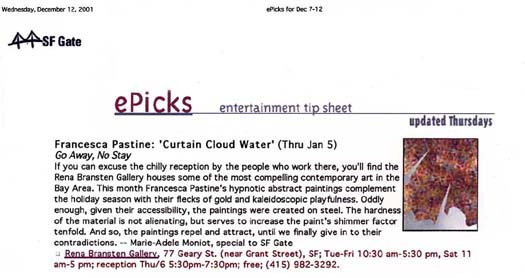
Spread: Rena Bransten Gallery, Flash Art: October 1998
reviewed by Reena Jana
"Hung nearby were visually stunning works that straddled both the real and the abstract...Francesca Pastine's gorgeous gouaches, including the ethereal Untitled, which featured delicate renditions of false eyelashes painted in irridiscent colors."